

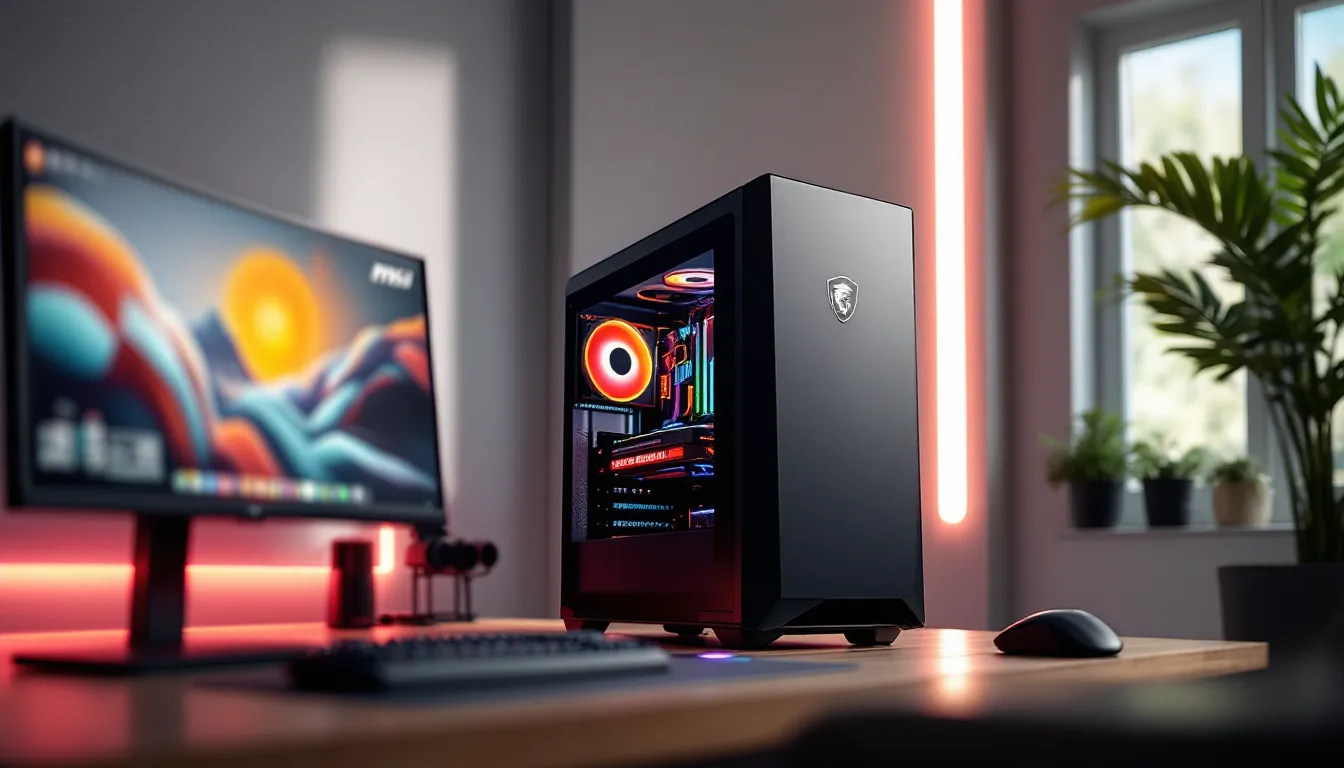

Choosing an MSI gaming desktop in 2026 means stepping into a landscape where pre-built systems have shed their old reputation for mediocrity and bloat. MSI has carved out serious street cred among gamers who want plug-and-play power without compromising performance or aesthetics. Whether you’re hunting for an msi prebuilt gaming pc to dive straight into competitive matches or need a rig that handles streaming, content creation, and AAA titles at max settings, MSI’s lineup spans from budget-friendly to absurdly high-end. This guide breaks down everything you need to know, from series breakdowns and specs to real-world performance and where MSI stacks up against the competition. Let’s dig in.
Key Takeaways
- MSI gaming desktops offer superior vertical integration with MSI-manufactured GPUs, motherboards, and cooling solutions that work seamlessly together, ensuring better quality control than generic pre-builts.
- The MPG series provides the best performance-per-dollar value for gamers, delivering 1440p ultra gaming with RTX 4070 Super/Ti and Ryzen 7 7800X3D processors at $1,800–$2,200.
- MSI’s thermal engineering consistently outperforms competitors like Alienware and ASUS in sustained workloads, keeping CPUs under 75°C during gaming with customizable fan curves that minimize noise.
- An msi gaming desktop eliminates 10–15 hours of research and assembly while offering factory-validated component pairings and warranties that avoid compatibility issues found in DIY builds.
- Upgrading an MSI system is straightforward thanks to standard ATX layouts, accessible M.2 slots, and PCIe 4.0/5.0 support, making long-term investment in your gaming rig practical and cost-effective.
- MSI gaming desktops excel beyond gaming for streamers and content creators, with features like Creator Mode in MSI Center and hardware that handles 4K video editing and AI workflows without performance drops.
What Makes MSI Gaming Desktops Stand Out?
MSI’s Gaming Heritage and Innovation
MSI didn’t just wander into the gaming desktop market last year. The company has been a mainstay in gaming hardware since the late ’90s, starting with motherboards and graphics cards before expanding into complete systems. Their Dragon Center software (now rebranded as MSI Center in 2025) gives users granular control over RGB lighting, fan curves, and performance profiles without the bloatware that plagues some competitors.
What sets MSI apart is their vertical integration. They manufacture their own GPUs, motherboards, and cooling solutions, which means tighter quality control and better component synergy. When you buy an msi gaming computer, you’re getting parts engineered to work together, not just a hodgepodge of off-the-shelf components thrown into a case.
Build Quality and Design Philosophy
MSI’s design language leans aggressive without tipping into over-the-top gamer kitsch. Expect angular lines, customizable RGB zones, and tempered glass panels that show off the internals. The chassis materials vary by series, but even entry-level models use steel frames with decent cable management.
Cooling is where MSI flexes. Most msi gaming desktops ship with at least one 120mm AIO liquid cooler or robust tower air coolers, paired with strategically placed intake and exhaust fans. Thermal performance across their lineup consistently beats similarly priced competitors in independent testing. MSI also tends to leave room for expansion, extra drive bays, additional RAM slots, and accessible PCIe lanes make future upgrades less of a headache.
MSI Gaming Desktop Series Breakdown
MAG Series: Performance Meets Affordability
The MAG (Arsenal Gaming) series is MSI’s entry point for gamers on a budget who still demand 1080p high-refresh or 1440p gaming. Typical configs pair an Intel Core i5-14400F or AMD Ryzen 5 7600X with an NVIDIA RTX 4060 or RTX 4060 Ti. You’ll find 16GB DDR5 RAM and 512GB NVMe SSDs as standard, though some models bump that to 1TB.
MAG desktops use simpler cooling solutions, usually a single-fan AIO or tower cooler, but they’re more than adequate for the mid-range chips inside. The cases are less flashy, but they’re functional and support standard ATX motherboards for easy component swaps down the line.
MPG Series: Mid-Range Powerhouses
The MPG (Mid-Range Performance Gaming) series is the sweet spot for most gamers. These rigs ship with Intel Core i7-14700KF or AMD Ryzen 7 7800X3D CPUs paired with RTX 4070 Super or RTX 4070 Ti GPUs. RAM starts at 32GB DDR5, and storage typically includes a 1TB Gen 4 NVMe SSD plus a secondary drive bay.
MPG models feature beefier cooling, think 240mm or 280mm AIOs with RGB pump blocks and additional case fans for positive airflow. The custom desktop builds crowd often compares their work against MPG systems because the performance-per-dollar is competitive.
Expect better cable management, tempered glass side panels, and MSI’s Mystic Light Sync for unified RGB across all components. These systems handle 1440p ultra settings in most AAA titles and can push 4K with some tweaks.
MEG Series: Ultimate Enthusiast Rigs
If money isn’t a concern and you want the absolute best, the MEG (Enthusiast Gaming) series delivers. We’re talking Intel Core i9-14900KS or AMD Ryzen 9 7950X3D with RTX 4090 or dual GPU setups in select models. RAM configurations start at 64GB DDR5-6000, and storage options include multiple Gen 5 NVMe drives in RAID.
Cooling is overkill in the best way, 360mm AIOs, custom loop-ready chassis, and sometimes factory-installed custom loops with RGB reservoirs and hard tubing. MEG cases are massive, often resembling premium gaming enclosures with built-in fan controllers and tempered glass on multiple sides.
These systems aren’t just for gaming. They excel at 4K rendering, video editing, AI workloads, and running multiple VMs. According to Tom’s Hardware, the MEG Aegis Ti5 posted some of the highest multi-core benchmarks in the pre-built category during 2025 testing.
Trident Series: Compact Gaming Solutions
The Trident series proves that msi pc gaming doesn’t have to mean a hulking tower. These compact rigs fit into small form factor (SFF) cases, some barely larger than a console, while still packing serious hardware.
Current Trident models use RTX 4060 Ti or RTX 4070 GPUs with custom low-profile cooling, paired with Core i5 or Ryzen 5 chips. Thermals are the trade-off here: Trident systems run warmer under sustained load compared to their full-sized siblings, but MSI uses vapor chamber cooling and high-static-pressure fans to keep temps manageable.
Ideal for LAN party enthusiasts, living room setups, or anyone who values desk space. Expansion is limited, usually one or two M.2 slots and minimal room for additional drives, but for gamers who don’t tinker much, that’s a non-issue.
Key Specifications to Consider
CPU and GPU Configurations
The CPU-GPU pairing is the heart of any gaming rig. MSI tends to match components intelligently, no Core i9 bottlenecked by an RTX 4060, and no overkill GPU starved by a weak CPU.
For 1080p gaming at 144Hz or higher, an RTX 4060 or 4060 Ti with a Ryzen 5 7600X or Core i5-14400F hits the mark. Competitive esports titles like Valorant, CS2, and Apex Legends will sit comfortably above 200 FPS on high settings.
1440p gamers should target RTX 4070 or 4070 Super GPUs paired with at least a Ryzen 7 7800X3D or Core i7-14700KF. The 7800X3D’s 3D V-Cache gives it a noticeable edge in CPU-bound games like Total War: Warhammer III and Starfield.
4K demands RTX 4080 or 4090 territory, and you’ll want a flagship CPU to avoid bottlenecks in open-world titles with heavy physics simulations.
RAM, Storage, and Cooling Systems
RAM speed matters more in 2026 than it did a few years ago. MSI ships most systems with DDR5-5600 or faster, and the performance delta between DDR5-5600 and DDR5-6400 can hit 5-8% in memory-intensive games. 16GB is the minimum for gaming, but 32GB is now the standard in mid-range and up.
Storage has shifted almost entirely to NVMe SSDs. Gen 4 drives are common, with Gen 5 appearing in MEG and high-end MPG models. Load times in games like Baldur’s Gate 3 or Cyberpunk 2077: Phantom Liberty shrink noticeably on Gen 5 compared to Gen 3.
Cooling directly impacts boost clocks and longevity. MSI’s AIO coolers typically keep CPUs under 75°C during gaming loads. Their custom fan curves ramp up gradually, so noise stays low until you’re really pushing the system. For those considering alternative gaming desktop options, MSI’s thermal engineering remains a standout feature.
Connectivity and Expansion Options
Front-panel I/O on recent MSI models includes USB-C 3.2 Gen 2, multiple USB-A ports, and combo audio jacks. Rear I/O depends on the motherboard tier but usually features:
- USB 3.2 Gen 2×2 (20Gbps)
- Wi-Fi 6E or Wi-Fi 7 with Bluetooth 5.3
- 2.5Gb Ethernet (Killer or Intel NICs)
- HDMI 2.1 and DisplayPort 1.4a outputs
PCIe 4.0 or 5.0 slots allow for GPU upgrades, capture cards, or additional NVMe adapters. MAG and MPG models typically have at least two accessible M.2 slots: MEG systems often feature four or more.
Performance Benchmarks: How MSI Gaming Desktops Stack Up
Gaming Performance Across Different Titles
Real-world FPS matters more than synthetic benchmarks. Here’s how typical MSI configs perform in popular 2026 titles:
1080p Ultra (MAG series with RTX 4060 Ti, Ryzen 5 7600X):
- CS2: 280-320 FPS
- Fortnite (DX12): 210-240 FPS
- Elden Ring: 60 FPS locked (engine limit)
- Call of Duty: Modern Warfare III: 150-180 FPS
1440p Ultra (MPG series with RTX 4070 Super, Ryzen 7 7800X3D):
- Cyberpunk 2077: Phantom Liberty (path tracing off): 95-110 FPS
- Baldur’s Gate 3: 120-140 FPS
- Starfield: 80-95 FPS
- Valorant: 400+ FPS
4K Ultra (MEG series with RTX 4090, Core i9-14900KS):
- Cyberpunk 2077 (path tracing + DLSS 3.5): 70-85 FPS
- Red Dead Redemption 2: 95-110 FPS
- Microsoft Flight Simulator 2024: 60-75 FPS (high-density areas)
- Remnant II: 100-120 FPS
These numbers align closely with independent testing from PCWorld, which praised MSI’s factory overclocks and stable boost behavior under extended gaming sessions.
Content Creation and Multitasking Capabilities
MSI gaming desktops aren’t one-trick ponies. The same hardware that crushes games also handles content creation workloads.
A typical MPG system with a Ryzen 7 7800X3D and 32GB DDR5 encodes 4K video in DaVinci Resolve about 15-20% faster than similarly priced Alienware models, thanks to better thermal management and factory RAM tuning. Premiere Pro timeline scrubbing stays smooth even with multiple 4K streams and color grading layers.
MEG rigs with 64GB RAM and RTX 4090 GPUs accelerate AI workflows in tools like Stable Diffusion, Midjourney local instances, and Topaz Video AI. Render times for Blender Cycles scenes drop by 40-50% compared to RTX 4080-based systems, and Unreal Engine 5 Lumen baking sees similar gains.
Streamers benefit from NVIDIA’s NVENC encoder on RTX 40-series cards. Dual PC streaming setups are overkill when you can stream at 1080p60 or 1440p60 with minimal FPS impact. OBS records at high bitrates without dropped frames, and the extra cores in i7/i9 or Ryzen 7/9 chips handle Discord, browser tabs, and chat overlays without hitching.
Who Should Buy an MSI Gaming Desktop?
Competitive Esports Players
If you’re grinding ranked in Valorant, League of Legends, or CS2, frame rates and input latency trump visual fidelity. An MSI MAG or MPG system with a high-refresh CPU like the Ryzen 7 7800X3D and an RTX 4060 Ti or 4070 delivers the consistent 240+ FPS needed for competitive play.
MSI’s low-latency mode in their BIOS and Killer NIC software prioritizes game traffic, shaving milliseconds off ping in online matches. Pair that with a quality gaming headset for positional audio, and you’ve got a solid foundation for climbing leaderboards.
Casual and AAA Gamers
For gamers who want plug-and-play convenience without researching every component, an msi prebuilt gaming pc checks the boxes. The MAG and MPG series hit the sweet spot: strong 1080p/1440p performance, enough overhead for upcoming titles, and pre-installed Windows 11 with drivers ready to go.
You’re not wrestling with BIOS updates, driver conflicts, or troubleshooting POST errors. Just unbox, plug in, and start downloading your Steam library.
Streamers and Content Creators
Dual-purpose users who game and create content will appreciate the MPG and MEG series. The combination of high core counts, fast RAM, and powerful GPUs means you can edit a YouTube video, export it, and jump into a game without closing apps or stuttering.
MSI Center’s Creator Mode adjusts fan curves and power profiles for quieter operation during recording sessions, then switches back to performance mode for gaming. The inclusion of powerful desktop hardware in pre-configured systems saves hours of benchmarking and tweaking.
MSI Gaming Desktop vs. Competitors
MSI vs. ASUS ROG
ASUS ROG desktops (especially the Strix and G-series) are MSI’s closest rivals. Both brands offer similar component tiers and pricing, but there are differences.
MSI generally undercuts ASUS by $100-$200 at equivalent spec levels. An MPG system with an RTX 4070 Super and Ryzen 7 7800X3D runs around $1,800-$2,000, while the comparable ROG Strix sits closer to $2,100-$2,300. ASUS leans harder into premium aesthetics, more aluminum, intricate RGB patterns, but MSI’s thermal performance edges ahead in sustained workloads.
ASUS Armoury Crate is more feature-rich than MSI Center, but it’s also buggier and resource-heavier. If you prioritize stability over flashy software, MSI wins.
MSI vs. Alienware
Alienware (Dell’s gaming brand) focuses on distinctive industrial design and brand cachet. Their Aurora R16 series features tool-less upgrades and unique chassis shapes, but thermal throttling has been a persistent complaint since the R13 generation.
MSI gaming desktops consistently outperform Alienware in cooling efficiency. Independent reviews from TechRadar found that MSI MPG systems maintained higher sustained boost clocks during hour-long gaming sessions compared to the Aurora R16, even though using the same CPUs.
Alienware charges a premium for the brand, expect to pay 15-25% more for similar specs. MSI offers better value, though Alienware’s customer support and warranty service (especially with Dell’s ProSupport Plus) edges ahead if you prioritize hand-holding.
MSI vs. Custom-Built PCs
The age-old debate: pre-built or DIY? Custom builds offer maximum flexibility and the satisfaction of assembling your rig, but they demand time, research, and comfort with troubleshooting.
An msi gaming computer saves you 10-15 hours of research, assembly, and setup. MSI warranties cover the entire system, no finger-pointing between component manufacturers when something fails. You also get factory overclocks and validated component pairings that avoid compatibility issues.
Cost-wise, MSI pre-builts in 2026 run about 10-15% more expensive than equivalent DIY builds if you’re savvy with sales and rebates. That gap has narrowed significantly compared to pre-pandemic pricing, when pre-builts carried a 30%+ markup. For first-time PC gamers or those who value their time, the convenience premium is reasonable.
Pricing and Value Considerations
Entry-Level Options Under $1,500
MAG series desktops dominate this tier. A typical $1,200-$1,400 config includes:
- Intel Core i5-14400F or AMD Ryzen 5 7600
- NVIDIA RTX 4060 (8GB VRAM)
- 16GB DDR5-5600
- 512GB NVMe SSD
- 550W 80+ Bronze PSU
This setup handles 1080p high-refresh gaming and most esports titles at competitive frame rates. It’s ideal for budget-conscious gamers or those upgrading from aging consoles.
Mid-Range Sweet Spot: $1,500-$3,000
MPG models fill this bracket with configurations that balance price and performance. At $1,800-$2,200, expect:
- AMD Ryzen 7 7800X3D or Intel Core i7-14700KF
- NVIDIA RTX 4070 Super or RTX 4070 Ti
- 32GB DDR5-6000
- 1TB Gen 4 NVMe SSD
- 240mm AIO cooler
- 750W 80+ Gold PSU
This range offers the best performance-per-dollar and handles 1440p ultra settings across virtually all current titles. It’s future-proof enough to stay relevant for 3-4 years without major upgrades.
Premium Tier: $3,000 and Above
MEG systems and high-end MPG configs occupy the enthusiast space. From $3,000 to $5,500+, you’re looking at:
- Intel Core i9-14900KS or AMD Ryzen 9 7950X3D
- NVIDIA RTX 4080 Super or RTX 4090
- 64GB DDR5-6400
- 2TB Gen 5 NVMe + 2TB secondary storage
- 360mm AIO or custom loop cooling
- 1000W+ 80+ Platinum PSU
These rigs target 4K gaming, high-end VR, professional content creation, and multi-purpose workstations. The price is steep, but diminishing returns kick in hard above $4,000 unless you’re monetizing your work or chasing absolute peak performance.
Where to Buy and What to Look For
Authorized Retailers and Official Channels
Buying directly from MSI’s official store guarantees authenticity and full warranty coverage. They occasionally run promotions with bundled peripherals (keyboards, mice, headsets) that add value.
Authorized retailers include:
- Best Buy: Frequent in-store demos, easy returns, and Geek Squad support options.
- Newegg: Competitive pricing, bundle deals, and detailed spec breakdowns.
- Amazon: Fast shipping with Prime, but double-check that the seller is MSI or an authorized reseller to avoid third-party gray market units.
- Micro Center (US): In-store pickup, knowledgeable staff, and occasional open-box discounts.
Avoid sketchy third-party sellers on eBay or unverified Amazon storefronts. Counterfeit MSI systems and refurbished units passed off as new do exist, especially during high-demand periods.
Warranty, Support, and Return Policies
MSI offers a standard 2-year limited warranty on most gaming desktops, covering parts and labor. Premium models sometimes include 3-year coverage. The warranty is non-transferable, so buying used means you’re on your own if something breaks.
Support quality is solid but not exceptional. Phone and chat support are available, though response times can stretch during peak hours. MSI’s online knowledge base and community forums are useful for common troubleshooting.
Return policies depend on the retailer. Best Buy allows 15-day returns (30 days for Elite members), while Newegg enforces a strict 30-day window with restocking fees on opened systems. Amazon’s return policy is the most generous at 30 days, no questions asked, though you’ll eat return shipping costs on large items.
Tips for Maximizing Your MSI Gaming Desktop Experience
Optimizing System Settings and Software
Out of the box, MSI systems are tuned for balanced performance, but you can squeeze more out of them with a few tweaks.
MSI Center is your first stop. Enable Game Mode to prioritize system resources for your active game and disable background tasks. The User Scenario profiles (Gaming, Silent, Extreme Performance) adjust fan curves and power limits on the fly.
In Windows 11, disable unnecessary startup apps via Task Manager. Steam, Discord, and RGB software all launch by default and chew up RAM. Keep only what you actually use.
Update GPU drivers regularly. NVIDIA’s Game Ready drivers often include day-one optimizations for new releases. MSI usually ships systems with slightly outdated drivers, so hitting GeForce Experience or AMD Adrenalin immediately after setup is smart.
For competitive gamers, enable Resizable BAR (ReBAR) in the BIOS if it’s not already active. This feature boosts performance by 3-8% in supported titles with minimal effort.
Upgrading Components Over Time
One of the advantages of an msi prebuilt gaming pc is the upgrade path. MAG and MPG systems use standard ATX or Micro-ATX boards, so swapping components is straightforward.
RAM is the easiest upgrade. Most systems ship with two DIMMs, leaving two slots open. Adding another 16GB or 32GB is plug-and-play, just match the speed and latency.
Storage expansion is similarly simple. Extra M.2 slots or SATA bays let you add SSDs or HDDs without removing existing drives.
GPU upgrades require checking PSU wattage. If you started with a 550W PSU and an RTX 4060, jumping to an RTX 5080 (or whatever NVIDIA releases next) will likely need a PSU swap to 750W or higher. MSI uses standard ATX PSUs, so replacements are easy to source.
CPU upgrades depend on the socket. AM5 boards (AMD) and LGA 1700 (Intel 13th/14th gen) will support future CPU generations with BIOS updates, giving you a clear path to drop in a newer chip when prices drop or your workload demands it.
Conclusion
MSI gaming desktops in 2026 represent a mature, competitive option for gamers who want reliable performance without the hassle of DIY assembly. From the budget-friendly MAG series to the absurd power of MEG rigs, there’s a config for every use case and budget. Thermal design, component synergy, and competitive pricing make MSI a strong contender against ASUS, Alienware, and custom builds.
If you’re shopping for an msi gaming desktop, focus on matching your monitor resolution and refresh rate to the GPU tier, prioritize at least 32GB RAM if you multitask or create content, and buy from authorized retailers to protect your warranty. The ecosystem is solid, the performance is there, and the upgrade path keeps your investment relevant for years. Whether you’re fragging in esports, exploring open worlds, or rendering your next video project, MSI has a desktop that’ll handle it.